Change language

Production processes polyester fibers

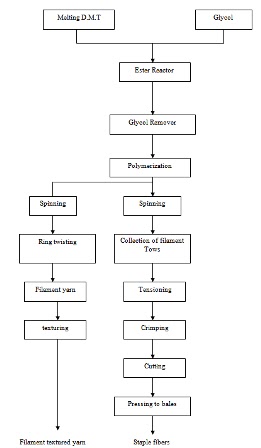
Production processes for manufacturing polyester fibers and yarns, as explained in the following: 

Production of ester building unit
In this process a chemical reaction is carried out between monoethylene glycol and dimethyl terephthalate to produce diglycol terephthalate.

Polymerization
In this process (for fiber production) polymerization occurs to diglycol terephtalate to produce polyester polymer. 

Spinning
In this process, molten polyester polymer is pumped to the spinnerettes and the filaments come out to meet a stream of cold air and get solidified. The resulting filament tows collected

Manufacturing process of nylon fibers and nylon yarns

Manufacturing nylon fibers and nylon yarns, as explained in the following: 

Polycondensation
This is a chemical process to produce the nylon polymer using caprolactum and acetic acid.

Chipping
The nylon rope produced from the polymerization process is cut into chips.

Melting
In this stage nylon chips are melted to reach the viscosity suitable for pumping to the spinning process. 

Spinning
In this process, molten nylon is pumped to spinnerettes, and the polymer streams coming out are cooled by blown air that let the polymer solidifies and form continuous nylon filament.

Drawing and twisting
The nylon yarn produced in the previous process is subjected to stretch, is given twist and is

production processes for viscose fibers and filament yarns,

Soaking in caustic soda
In this process the wood pulp is soaked in sodium hydroxide to produce soda cellulose which is squeezed to remove the extra caustic soda solution .

Shredding
The crumbs of soda cellulose are shredded to produce small flakes.

Ageing
In this process, the shredded soda cellulose is aged for a certain time to adjust the molecular structure. 

Xanthating
The aged cellulose is mixed with carbon disulphide to produce by chemical reaction xanthate 

Dissolving
The xanthat is dissolved in sodium hydroxide to produce xanthate solution for spinning. 


De-aeration and filtration
In this process, the xanthate solution is stored in tanks under vacuum to remove any air bubbles, and is passed through multi stage filters to remove any trash particles, and when

Production processes for transforming woven or knitted fabrics into garments


Fabric laying
In this process the fabric is laid on a long table in multilayer arrangement, using a special machine with reciprocating carriage. This process is applied for the main garment fabric, and also the lining fabric. 

Placing patterns
After collecting the number of fabric layers, the patterns of the garment are placed on top of the layers, and fixed by special pins. 

Cutting
The multilayers are cut according to the patterns by using electric cutter which moves around the patterns to produce garment parts and, similarly lining parts and interlining parts 

Sewing
In this process, the garment parts are assembled together by stitching on sewing machines. Also, the lining

Production processes for finishing woven cotton fabrics and woven synthetic fabrics.


Singeing
This process (cotton only) is considered one of the processes for finishing preparation, and is only concerned with cotton woven fabrics. In this process the greige fabric surface on both sides is subjected to a gas flame which burns the protruding fibers and results in a smooth surface.

Desizing
In this process the size materials on the warp threads of the fabric are removed, by passing the fabric in a bath of sulpheric acid or by using enzymes, soap or hot water depending on the sizing material. This process is also considered one of the preparation processes for finishing. 


Scouring
In this process, the desized fabric is passed through a cleaning bath, using alkaline or solvent solutions to dissolve any impurities or soiling on the fabric. Desizing and scouring could be

Technology of tufted carpet


In the technology of tufted carpet , the tufting machine is fed with a large number of threads, and a spun-bonded nonwoven fabric, as the ground of the carpet. The needles of the tufting machine make tracks of parallel stitches through the ground fabric, creating a terry surface. The formed carpet is back coated with adhesive resin to bind the carpet pile to the ground fabric and the adhesive is covered with jute fabric as a back. Then, the carpet surface is sheared to improve the appearance and regulate it.  


Production processes for weaving yarns

The production processes for weaving yarns into fabric starts with a large number of parallel threads are arranged with the required length, wound on a beam, strengthened and smoothed by sizing, and interlaced with weft threads on the loom to produce a woven fabric, which is wound on another beam (cloth beam).  


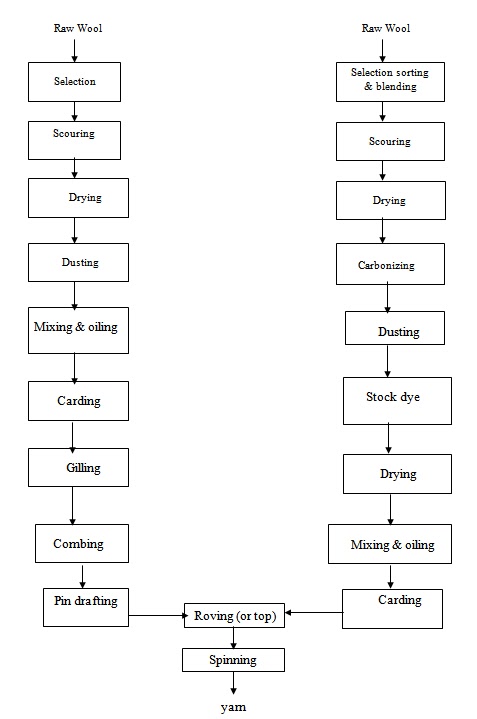
Steps in wool spinning


In wool spinning, wool fibers from bales are scoured to be cleaned from grease, carbonized to remove the plant matter, carded, combed then drafted to a thin thread and twisted to produce woolen or worsted yarns. The produced yarn is wound on large package as final product for weaving or knitting, or for carpet production. 

The same line may be used to process man-made fibers of the type similar to wool, or blends of wool and man-made fibers. 

Cotton and synthetic knitted hose: Production Process

Cotton gin and production process flow sheet

Flowchart of cotton spinning


Flowchart of cotton spinning


In cotton spinning, cotton from bales is cleaned from dust, trashes and foreign matters, opened, mixed, carded, then drafted to a thin thread and twisted to produce the yarn. 


This line could also be used for spinning man-made fibers with characteristics similar to cotton, or blends of cotton and man-made fibers. The produced yarn is wound on large packages with conical shape on winding machines producing cone packages.

Related posts
 
Cotton gin and production process flow sheet
Cotton and synthetic knitted hose: Production Process
Blog Directory